
Chi Kan, Kaiping: A First-Person Journey Through China’s Diaolou Heritage
Written By 杨文金, Photographer: 甄凤桃
Videographer: Jennifer Yeung
Editor: Jeff Leung
December 10, 2025

I arrived in Chi Kan, Kaiping, without quite realizing how deeply it would stay with me. I expected a beautifully restored ancient town, perhaps charming, perhaps performative. What I encountered instead was something far more grounded — a place where history does not announce itself, but quietly breathes.
Chi Kan matters because it is not merely a destination; it is a living record of the Chinese diaspora. Kaiping is the ancestral homeland of millions of overseas Chinese, and Chi Kan was once a thriving commercial center where money, letters, and ideas returned home from across the world. Walking its streets felt less like sightseeing and more like listening to a long, unresolved conversation between those who left and those who stayed.

At the heart of this story are the Diaolou. These fortified watchtowers define Kaiping’s landscape, and seeing them in person makes their purpose unmistakably clear. Built from the late Qing Dynasty through the Republican era, they were designed to defend villages against banditry while serving as family homes. Many were funded by relatives abroad — people who had crossed oceans, endured hardship, and sent their success home in concrete form.
What struck me most was their architectural confidence. Roman arches sit beside Chinese rooflines; Baroque curves meet iron-barred windows. These buildings are not confused hybrids — they are fluent in multiple worlds at once. Standing beneath one, I felt ambition, fear, pride, and hope compressed into brick and stone.

Chi Kan unfolds slowly. Canals wind through the town, reflecting grey-brick houses, colonial façades, and overhanging trees. Stone bridges rise gently over the water, elegant without effort. The town is quiet but never empty, its rhythm set by footsteps, water, and time.
One building in particular caught my attention — its façade marked simply with the year “1926.” With its arched entrance, symmetrical proportions, and red-framed windows, it speaks clearly of Western influence, yet feels entirely at home here. This is Chi Kan’s strength: global ideas absorbed and reshaped through a deeply Chinese lens.

Walking the town reveals layers. Along main streets, arcaded buildings and balconies hint at former prosperity. Bougainvillea spills over railings in unapologetic color. Cafés line the canals with restraint, aware they are guests in a far older story.
Up close, the Diaolou feel less like monuments and more like witnesses. Some are restored, others worn and scarred by decades of sun and rain. Their silence is heavy with memory.
Churches and hybrid structures appear unexpectedly — red brick bell towers standing beside traditional Lingnan homes — reminders that belief and culture traveled alongside people, evolving as they went.
If the Diaolou are Chi Kan’s bones, the waterways are its bloodstream. They slow the pace, connect spaces, and invite stillness. Sitting beside the water, watching reflections dissolve and reform, I realized how rare it is to encounter a place that does not rush you.
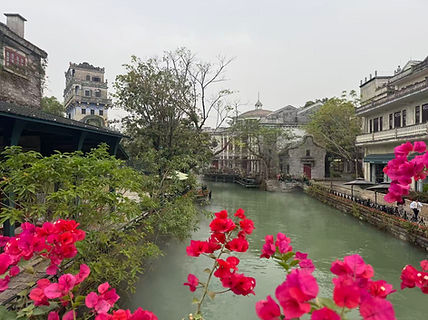


Chi Kan does not demand attention. It rewards patience. There is quiet humor too — fortified towers now guarding cafés, defensive walls now welcoming travelers. What was built for protection now offers reflection.
Chi Kan is not a spectacle. It is accumulated meaning. It tells the story of migration without slogans, globalization without branding, and identity without explanation. I left feeling that I had not simply visited a destination, but briefly stepped into the echo of countless lives — and that is something no modern attraction can manufacture.


简体中文版本(现代文化旅游风格,含文学表达)
初到开平赤坎,我并未预料这座水乡古镇会在心中留下如此深刻的回响。我原本以为这会是一处修复精致、适合游览的古镇,但真正走进去后才发现,这里的历史并不张扬,它安静地存在着,等待被感受。
赤坎之所以重要,是因为它不仅是一座古镇,更是一段关于华人迁徙的集体记忆。开平是数百万海外华人的祖籍地,而赤坎曾是侨汇、商业与文化交流的重要节点。行走其间,更像是在倾听一段跨越百年的对话——关于离开、回归、牵挂与身份。
碉楼是这段历史最具象的表达。建于清末至民国时期的碉楼,高耸而坚固,既是防御土匪的堡垒,也是家族生活的空间。许多碉楼由海外华侨出资兴建,将异乡奋斗的成果化为家乡的安全与尊严。
碉楼的建筑语言令人难忘。罗马拱券与中式屋脊并存,巴洛克曲线与铁窗相遇。这不是杂糅,而是一种自信的融合,体现了那个时代华侨所拥有的世界视野与文化认同。
赤坎的节奏舒缓而从容。河道贯穿古镇,倒映着灰砖民居、骑楼立面与树影。石桥轻拱,水面平静,让人不自觉地放慢脚步。这里安静,却充满生活气息。
一栋立面标注着“1926”的建筑让我印象尤为深刻。拱形入口、对称布局、红色窗框,带着明显的西式风格,却毫不突兀地融入环境之中。这正是赤坎的魅力所在——世界经验在地化,中国气质全球化。
沿街而行,骑楼与阳台诉说着昔日的繁荣,三角梅从栏杆间倾泻而下,为岁月增添色彩。河岸边的咖啡馆安静克制,仿佛懂得自己只是历史长河中的过客。
近距离凝视碉楼,它们更像是沉默的见证者。有的修复如新,有的斑驳陈旧,墙面记录着时间的痕迹。
赤坎还保留着教堂与中西合璧的建筑,红砖钟楼与岭南民居并肩而立,提醒着人们,信仰与文化同样随着迁徙而变化。
如果说碉楼是赤坎的骨骼,那么水就是它的血脉。河道连接空间,也放慢时间。坐在水边,看倒影被轻轻打散又重新汇聚,是一种难得的松弛。
赤坎不喧哗、不催促,却回报耐心。曾经用于防御的建筑,如今迎接来访者。这里不是景点,而是一种积累的意义。离开时,我感受到的不是游览的结束,而是一段历史回声的延续。